Robert Di Donato Di Donato 1
Professor Lennon
Literature in the 21st Century
December 1, 2008
Option Two: Describe the four Texts
Going in chronological order, the first play I will go in depth about is “The Mercy Seat” by Neil LaBute. The premise behind this was this man, Ben, was having an affair with his boss, Abby. He was having the internal conflict of whether or not to manipulate the situation that was 9/11 to finally run off with Abby or to return to his family and continue being a cheat. It progresses and we finally see that he makes the right choice and goes back to his wife, inevitably hurting his mistress, Abby; hoping things go back to the way they were.
The main concept behind “The Mercy Seat” was that of morality. Do you do what is wrong or do you do what is just even if the situation pending makes the option so much sweeter. One section I believe portrays that beautifully is on page 63 and 64. We see Abby and Ben in yet again another argument about him making the phone call to what she believes is his wife. He explodes at her because she wants him to tell the truth and he just cannot do that. At this point in time, he is still weighing out the options in his mind whether or not to use 9/11 as a scapegoat to live a life with his mistress or to go back to his wife and children with his tail between his legs, admit he was wrong, and revert to the way things were. It finally hits him what the right, just thing to do is, and he makes the phone call, which unfortunately ends up being to Abby.
Di Donato 2
The next novel, which is actuality a memoir, is Jarhead by Anthony Swoffard. We enter into his life as a Marine. We go through his trials and tribulations as an incoming Marine and the experiences he goes through. As we get towards the end of the memoir, we finally come to see that Swoff never really does anything while in war, yet he recants to us that if one was not in war, they cannot say nor do anything negative about it because they were not there.
This piece of literature confused me about the theme behind it. To me, I personally see it as a jumbled mess of confusion. It has the feel of just babbling on to try and get a point across when there really is no point to be had. “To be a marine, a true marine, you must kill.”(Swofford, pg. 247) It is truly a powerful statement. Yet, we also have another statement that nullifies it. “… and thought at the time I was angry that the pompous captain took the handset from me and stole my kills, I have lately been thankful that he insisted on calling the fire mission, and sometimes when I am feeling hopeful or even religious, I think that by taking my two kills the pompous captain handed me life.” (Swofford, pg.257) Anthony mentions how one must kill to be a true marine, yet he, in fact, never killed. On a previous page, he tells us to listen while he talks because he signed up. “… but because I signed the contract and fulfilled my obligation to fight one of America’s wars, I am entitled to speak.” (Swofford, pg. 254) This entire memoir is just his way of complaining and has no real premise behind it. He is just rejoicing us with his tale. There is no real morality because he did what he had to do when told. He would have killed if told to. He would not have killed if not told to. This is just his ranting when he really has no right to rant since he himself admitted he is not a “real marine”.
Di Donato 3
Next on the agenda is the graphic novel Shooting War by Anthony Lappe and Dan Goldman. In this, we more or less see a young man, Jimmy Burns, get tossed into a foreign land after he gets amazing footage of a terrorist act in front of him. He was an active blogger who always streamed his opinion on the internet. The way he filmed the original attack got him a job for Global News which had him deep in the heart of a terrorist land. We discover the plans of the Hand of Mohammed, the main faction over there, and slowly but surely defeat them. But, after Jimmy sees several people get murdered before his eyes and his blog gets shut down, he retrieves a backup of his data and uploads it onto YouTube, showing the world what had really happened.
What I feel this graphic novel tries to display is that of truth. We have a man who was loved as well as hated for having a blog and posting his real feelings about certain topics. Then when the topic in question got a little too real for people to stomach, he was censored on his own public online journal. That is why I find the latter of the novel to be the best example of this. After Global news has his blog shut down, Dan Rather hands him his footage to place onto another worldwide renowned site to get his point across. It shows that no matter how graphic the content is, people should be able to see the truth whether they like it or not. It should not be up to the government to say how we, the people, should feel about certain things. If we want to know what is going on, we will look for the detailed stuff like Jimmy uploaded. If we want something a bit more G-rated, we will watch the 10 o’clock news or pick up the New York Times. It is all about expressing our opinion, no matter how factual or brutal it truly is.
Di Donato 4
Last on our list of reading material is the play “The Pillowman” by Martin McDonagh. We find out that we are in a communist land with three people in an enclosed interrogation room. We have Katurian, a writer of very vivid novels, and two cops, Detective Tupolski and Officer Ariel. The two authority figures believes that Katurian and his brother, Michal, have committed three murders; the slicing of a child’s toes to make him bleed out, feeding a little girl razor blades in apples, and a recreation of Jesus Christ. As we read on, we find out that Michal had performed these heinous acts and blamed Katurian for writing such graphic stories which warped his mind. After being hurt by his brother’s actions, he suffocates him with a pillow, the same way he did his parents. As Katurian writes a confession, he asks simply to not have his work destroyed so that his legacy would live on. After they find out that the confession was falsified and that the third child, the Jesus Christ kill, was never actually murdered, they kill him for the previous murders yet let his work remain.
What this is about in my opinion is that of memory. The thought of Katurian’s past is what made him write such amazing novels. If not for Michal’s beatings, he would not have written as well. We see what Katurian is placed on his knees, about to get shot point blank in the head, he continues to write to keep his legacy alive. He basically continues the tale of “The Writer and his Brother” by adding a specific ending to it. He added where the Pillowman, one of Michal’s favored story characters, comes in and asks Michal if he would choose to kill himself now. He merely responds that if he does die, his brother will not hear his torture, and his stories will not be as good. He retorted once more that he will suffer through it because he felt that one day, he would like the stories
Di Donato 5
and would be happy to read them. We see that even at the time of his death, much like the philosopher Socrates, the thing they were being put to death for they were still doing. They did not care about themselves, but about the memory of their work and what they stood up for; they believed in.
Tuesday, December 2, 2008

Wednesday, November 12, 2008
What does the house look like
HOUSES
R
Just
H
only when they are not.
Your job: what does the H look like? On your own blog under the title "HOUSE" I want you to post a picture or link to a picture. Then write a paragraph where you explain why you chose that particular image (since this is about a house that expands and contracts in a way that defies rationale thought, you might want to be a bit creative here). I then want you to find a paragraph in the book (or a couple of lines) that you quote that gave you the inspiration for your image.
http://www.acsu.buffalo.edu/~jconte/Images/Duchamp_Nude.jpg
The reason I chose this image was for the sole fact that it is Marcel Duchamp's "Nude Descending a Staircase, No. 2" instills an aspect of a home, like stairs, but in an erratic pose & context. We also have a person walking up or down the stairs, but you cant tell what the damned thing is or was. The jumbling of the artwork begs the question of where does it begin & where does it end, like a house that is constantly changing. How do you know the start of it or the end of it?
R
Just
H
only when they are not.
Your job: what does the H look like? On your own blog under the title "HOUSE" I want you to post a picture or link to a picture. Then write a paragraph where you explain why you chose that particular image (since this is about a house that expands and contracts in a way that defies rationale thought, you might want to be a bit creative here). I then want you to find a paragraph in the book (or a couple of lines) that you quote that gave you the inspiration for your image.
http://www.acsu.buffalo.edu/~jconte/Images/Duchamp_Nude.jpg
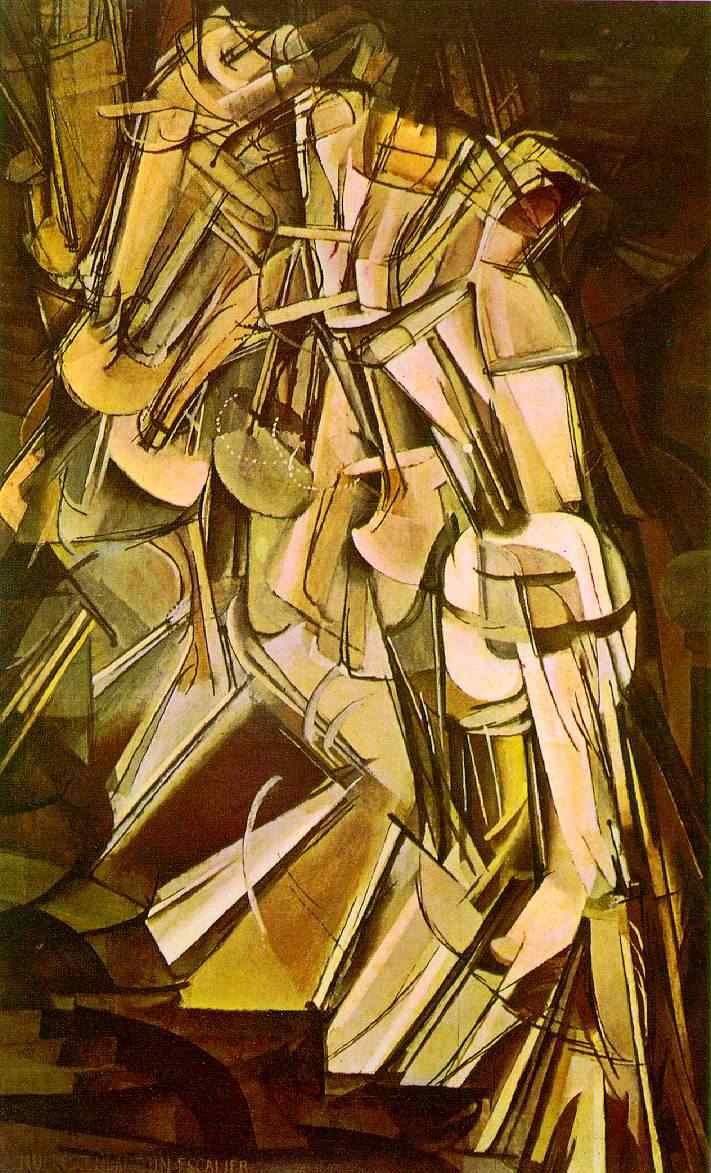
The reason I chose this image was for the sole fact that it is Marcel Duchamp's "Nude Descending a Staircase, No. 2" instills an aspect of a home, like stairs, but in an erratic pose & context. We also have a person walking up or down the stairs, but you cant tell what the damned thing is or was. The jumbling of the artwork begs the question of where does it begin & where does it end, like a house that is constantly changing. How do you know the start of it or the end of it?
Video
Images.
you do not read this book.
You w a t c h it.
On your own blog under the heading "VIDEO" post or link a video that is a visual of The House of Leaves. You can be literal and post a blog of Mark Danielewski reading from his book or you could be figurative and find a clip that relates to the book in some way.
After you post it or link to it, then I want you to write a paragraph where you explain why you chose your video.
http://www.youtube.com/watch?v=Gyug0q9eyqw&NR=1
I chose the video for the sole fact that it was a trailer & it gave slight clues on maybe how to read the novel itself. The way it scrolls from scene to scene explains how confusing the book actually can be if you dont read it exactly. It is eccentric to no avail, but that is what the allure is. You want to know what it is about & it keeps you guessing on what it is.
you do not read this book.
You w a t c h it.
On your own blog under the heading "VIDEO" post or link a video that is a visual of The House of Leaves. You can be literal and post a blog of Mark Danielewski reading from his book or you could be figurative and find a clip that relates to the book in some way.
After you post it or link to it, then I want you to write a paragraph where you explain why you chose your video.
http://www.youtube.com/watch?v=Gyug0q9eyqw&NR=1
I chose the video for the sole fact that it was a trailer & it gave slight clues on maybe how to read the novel itself. The way it scrolls from scene to scene explains how confusing the book actually can be if you dont read it exactly. It is eccentric to no avail, but that is what the allure is. You want to know what it is about & it keeps you guessing on what it is.
Character Sketch
who are these people that people the halls of this book?
If you last name starts with A-D you take Karen
If your last name starts with E-I you take Navy
If your last name starts with J-P you take Reston
If your last name starts with Q-U you take Holloway
If your last name starts V-Z you take Tom.
Find three passages from this book and give a character analysis of the person.
POST TO YOUR OWN BLOG POST UNDER THE HEADING "CHARACTER SKETCH"
"Karen does not look at the map again. she just smiles & takes a sip of Wax's beer. They continue talking, more about Wax's girl troubles, another round of 'dont worry, keep living, you're young' & then out of nowhere Wax leans over & kisses Karen on the lips. It lasts less than a second & clearly shocks her, but when he leans over & kisses her again she does not resist. In fact the kiss turns into something more than a kiss, Karen's hunger almost exceeding Wax's."
"The radio remains an incomprehensible buzz of static, but from somewhere in the house, rising up like some strange black oil, there comes a faint knocking. Chad & Daisy actually detect it first, but by the time they reach their parent's bedroom, Karen is already up with the light on, listening intently to this new disturbance."
"Karen says nothing when she hears Navidson make this comment, though she does get up abruptly to go out to the backyard & smoke a cigarette."
Reading these little tidbits about Karen, I can tell she is a cool, calm, collected person who doesnt mind fighting for what she may or may not believe in. She knows how to bite her tongue & when to speak at the right moments. She could have confronted Navidson but decided to relax & have a little nicotene break. When she heard knocking, however, she was the first one up to confront the issue. All together, though, she is just passionate. The way she kissed & knew how to defend the others along with herself, it shows she has a lot of heart.
If you last name starts with A-D you take Karen
If your last name starts with E-I you take Navy
If your last name starts with J-P you take Reston
If your last name starts with Q-U you take Holloway
If your last name starts V-Z you take Tom.
Find three passages from this book and give a character analysis of the person.
POST TO YOUR OWN BLOG POST UNDER THE HEADING "CHARACTER SKETCH"
"Karen does not look at the map again. she just smiles & takes a sip of Wax's beer. They continue talking, more about Wax's girl troubles, another round of 'dont worry, keep living, you're young' & then out of nowhere Wax leans over & kisses Karen on the lips. It lasts less than a second & clearly shocks her, but when he leans over & kisses her again she does not resist. In fact the kiss turns into something more than a kiss, Karen's hunger almost exceeding Wax's."
"The radio remains an incomprehensible buzz of static, but from somewhere in the house, rising up like some strange black oil, there comes a faint knocking. Chad & Daisy actually detect it first, but by the time they reach their parent's bedroom, Karen is already up with the light on, listening intently to this new disturbance."
"Karen says nothing when she hears Navidson make this comment, though she does get up abruptly to go out to the backyard & smoke a cigarette."
Reading these little tidbits about Karen, I can tell she is a cool, calm, collected person who doesnt mind fighting for what she may or may not believe in. She knows how to bite her tongue & when to speak at the right moments. She could have confronted Navidson but decided to relax & have a little nicotene break. When she heard knocking, however, she was the first one up to confront the issue. All together, though, she is just passionate. The way she kissed & knew how to defend the others along with herself, it shows she has a lot of heart.
When a House is not a House
THE HOUSE
is not a house.
It is much more.
It is a metaphor.
FOR WHAT?
In three paragraphs, I want you to decide what the house could stand for. Think this through. Please post this response on your own blog.
[check out my comment to this post for possible ideas]
I read about the house & how it constantly changes & personally considered it to be a metaphor for oneself. We as a people start out as a foundation just like a house. We have the same blueprints as anyone else; XX[female] & XY[male]. This is similar to a house having the same base content; concrete, windows, etc. As time goes on, the basis behind each thing, whether it be human or house, changes.
We see how when a boy or girl grows up, they dont stay the same way they were as an infant. They mature, they develop, & get different interests than from when they were younger. A house, much like humans, are always changing. You can have construction done to the interier or the exterier. Maybe pull up the rugs & put in hardwood floor. Hell. You could even put tile. But it can & always change. Even if you keep it the same, the things get older & more brittle... Just like us.
This book reminds me of the quote from Heraclitus that you can never step into the same river twice. Not only does the river which is forever flowing changes since it's new water rushing past, but you as an individual are different as well. First you went in dry & now the second time you're a slight bit moister & maybe even colder. The same is said with this house & us. You get into it & think you know it. Then at the drop of a dime it changes & then that all too familiar thing is but a distant memory & stands before you a whole new creation.
is not a house.
It is much more.
It is a metaphor.
FOR WHAT?
In three paragraphs, I want you to decide what the house could stand for. Think this through. Please post this response on your own blog.
[check out my comment to this post for possible ideas]
I read about the house & how it constantly changes & personally considered it to be a metaphor for oneself. We as a people start out as a foundation just like a house. We have the same blueprints as anyone else; XX[female] & XY[male]. This is similar to a house having the same base content; concrete, windows, etc. As time goes on, the basis behind each thing, whether it be human or house, changes.
We see how when a boy or girl grows up, they dont stay the same way they were as an infant. They mature, they develop, & get different interests than from when they were younger. A house, much like humans, are always changing. You can have construction done to the interier or the exterier. Maybe pull up the rugs & put in hardwood floor. Hell. You could even put tile. But it can & always change. Even if you keep it the same, the things get older & more brittle... Just like us.
This book reminds me of the quote from Heraclitus that you can never step into the same river twice. Not only does the river which is forever flowing changes since it's new water rushing past, but you as an individual are different as well. First you went in dry & now the second time you're a slight bit moister & maybe even colder. The same is said with this house & us. You get into it & think you know it. Then at the drop of a dime it changes & then that all too familiar thing is but a distant memory & stands before you a whole new creation.
Skip It
Johnny Truant writes, "The way I figure it, if there's something you find irksome--go ahead and skip it."
What is Mr. Truant implying about the book: If you only read the parts that you want and skip the parts that you don't care about, how will you get the whole story? Is he asking us to be lazy? Or does he know us better than we do and realize this is just what we were going to do anyway?
On your own blog under the title SKIP IT, write down the parts that you skipped when reading--and be honest. Did you read the first page and then just stop? did you read through the "main story" (whichever you think that is) and then just skip the rest? Did you switch back and forth.
write three-four paragraphs where you write down your experience reading this book. But do not write "I" or any first person. Have distance. Write about your self in the third person. Example: "After the second chapter, John Lennon could not read anymore of Johnny Truant's footnotes. They were so obviously sexist and boring and completely ridiculous. Mr. Lennon wanted to know about the hallways............"
Several sections were skipped. To really define which parts one cannot do at this moment because it was due to not knowing how or when to read it. Just note most of it was kind of absorbed while the rest is still under observation.
Reading this book made Rob a confuzzled panda of sorts. Scrolling through it, trying harder & harder to understand it, but was left too devastated to handle. Reading this conglomerate of confusion made this tattooed individual think of several old television shows & movies. More specifically was the Treehouse of Horror episode of the Simpsons when the family moves into the house & it begins to bleed, change rooms, & inevitably self destruct. Another movie was Thirteen Ghosts. The house begins to morph & twist into different shapes until it, too, self destructs.
When Truant mentions about skipping things that are irksome. Reading it made this junior believe that it wasn't a negative thing to 'skip over' it to forget. It was to skip over right now to reread it again later. It is not like said skipped item is not as important as the rest, but actually something to delve further into by means of reading between the lines or looking closer at to better understand. To skip means you either forget completely about it or go onto an easier section & then return.
House of Leaves was a lot like the first time reading a manga. Typically one reads a graphic novel from left to right. With japanese comics, you have to read it from right to left, not knowing if a panel collides, where to follow from. This was exactly the same feeling. You'd read it then magically a giant blue box is on the page & it's like, "Hrm... So where do we begin?" That same feeling still is felt while reading House of Leaves. Mangas, however, are a much simpler read. Maybe next novel should be one of those. ;-)
What is Mr. Truant implying about the book: If you only read the parts that you want and skip the parts that you don't care about, how will you get the whole story? Is he asking us to be lazy? Or does he know us better than we do and realize this is just what we were going to do anyway?
On your own blog under the title SKIP IT, write down the parts that you skipped when reading--and be honest. Did you read the first page and then just stop? did you read through the "main story" (whichever you think that is) and then just skip the rest? Did you switch back and forth.
write three-four paragraphs where you write down your experience reading this book. But do not write "I" or any first person. Have distance. Write about your self in the third person. Example: "After the second chapter, John Lennon could not read anymore of Johnny Truant's footnotes. They were so obviously sexist and boring and completely ridiculous. Mr. Lennon wanted to know about the hallways............"
Several sections were skipped. To really define which parts one cannot do at this moment because it was due to not knowing how or when to read it. Just note most of it was kind of absorbed while the rest is still under observation.
Reading this book made Rob a confuzzled panda of sorts. Scrolling through it, trying harder & harder to understand it, but was left too devastated to handle. Reading this conglomerate of confusion made this tattooed individual think of several old television shows & movies. More specifically was the Treehouse of Horror episode of the Simpsons when the family moves into the house & it begins to bleed, change rooms, & inevitably self destruct. Another movie was Thirteen Ghosts. The house begins to morph & twist into different shapes until it, too, self destructs.
When Truant mentions about skipping things that are irksome. Reading it made this junior believe that it wasn't a negative thing to 'skip over' it to forget. It was to skip over right now to reread it again later. It is not like said skipped item is not as important as the rest, but actually something to delve further into by means of reading between the lines or looking closer at to better understand. To skip means you either forget completely about it or go onto an easier section & then return.
House of Leaves was a lot like the first time reading a manga. Typically one reads a graphic novel from left to right. With japanese comics, you have to read it from right to left, not knowing if a panel collides, where to follow from. This was exactly the same feeling. You'd read it then magically a giant blue box is on the page & it's like, "Hrm... So where do we begin?" That same feeling still is felt while reading House of Leaves. Mangas, however, are a much simpler read. Maybe next novel should be one of those. ;-)
Tuesday, November 11, 2008
Confrontation with a fellow tagger
Reading [& seeing] about graffiti for this week made me wanna visit my cousin, PJ. He & I as I said in my previous post used to do a lot together. He'd BMX & skateboard while I bladed. He would take me to China town & hang out with his friends & do nerdy crap together like play Magic. We even tagged together.
Seeing as he is about 30 now & Im 20, our relationship has changed a bit. We bullshit about a lot of stuff... Now it's more or less about tattoos [he does them & I get them, etc] & how both of our aspirations for our art have grown. He went with permanent scarring of one's skin along with making clothing designs while I took the route of graphic novels. We both sat back, had a beer, lit up a cigarette, & just talked about it.
After talking for several hours, we got bored & hit up a few spots, thinking of the good ol' times. We just walked past a few murals & tags & just thought, "Damn... How the times have changed." The style of things, the ways they were done, & so forth. I personally loved how it all evolved. He wasnt exactly too fond of it, but he was always one for stability & lack of change. I saw the old school styles along with the new & it motivated me to take up my mask & cans & just do work.
Seeing as he is about 30 now & Im 20, our relationship has changed a bit. We bullshit about a lot of stuff... Now it's more or less about tattoos [he does them & I get them, etc] & how both of our aspirations for our art have grown. He went with permanent scarring of one's skin along with making clothing designs while I took the route of graphic novels. We both sat back, had a beer, lit up a cigarette, & just talked about it.
After talking for several hours, we got bored & hit up a few spots, thinking of the good ol' times. We just walked past a few murals & tags & just thought, "Damn... How the times have changed." The style of things, the ways they were done, & so forth. I personally loved how it all evolved. He wasnt exactly too fond of it, but he was always one for stability & lack of change. I saw the old school styles along with the new & it motivated me to take up my mask & cans & just do work.
Subscribe to:
Comments (Atom)